Showing posts with label camping. Show all posts

07 April 2012

Kariba

Most people who have never been to southern Africa are not aware that there is a very big lake on the Zambezi River called Lake Kariba. “Kariba” as the locals call it was, at the completion of its construction in 1960, the largest man-made lake in the world.  It is four times the size of the notable Three Gorges Dam in China.  From the small town built on the hills overlooking the dam wall, the lake stretches 140 miles (290km) to the southeast and is about 20 miles (32km) wide on average.
Map shows Lake Kariba - Zambia to the north, Zimbabwe to the  south

The massive project was undertaken to provide hydroelectric power for the growing industries of Zimbabwe and Zambia. Two power stations, one on the Zambian bank and the other on the Zimbabwean side are in full operation. Covering an area of 5,580 square kilometers (2,150 sq mi), its storage capacity is an immense 185 cubic kilometers (44.4 cu mi). The lake began to fill in 1958 and would become a year-round source of water for an abundance of animal and bird life, and a sunny playground for both local and foreign tourists. In places the lake is over 300 feet (90M) deep. A large commercial fishing industry developed here providing tons of sardine-like “kapenta” which provides a significant source of protein for a predominantly African clientele. There are huge populations of hippo and Nile crocodile in residence here and on the shorelines and major Game Reserves on the southern shore have incredible populations of wildlife.

The history of the construction of this engineering marvel, the story of the taming of the “River God” Nyaminyami, and the story of one of the most impressive wildlife rescue operations (Operation Noah) ever carried out in Africa, make for interesting reading. As the waters rose to flood the valley, over 5,000 animals were rescued, including 35 different mammal species and 44 black rhino. Frightened creatures ranging from elephant to snakes were captured for release into areas that now form Matusadona National Park and Chete Safari Area.
February 1970, two flood gates open

My first visit to Kariba was between Christmas 1966 and the New Year.  I was on a trip to “Rhodesia” from my home, at the time, in Grahamstown, South Africa where I was working at Rhodes University.  My friend Andrew Campbell-Watt who had been a fellow student at Rhodes, was living in Salisbury at the time.  He and I undertook a tour in my red Volkswagen Beetle and our first destination was Lake Kariba. It was love at first sight for me and after I moved to Rhodesia the following July, it would be the scene of a number of memorable experiences. 

One of the most striking things about the lake is its huge size. There are times when you are in a small boat that you lose sight of the shore completely and have to navigate by compass (or GPS today!). A ferry boat service runs from one end of the lake to the other and it is usually an overnight journey of 12 hours. To put its size in perspective, traveling from one end to the other would be a similar distance as driving from Colorado Springs to Cheyenne, Wyoming.

December is the middle of the hottest season of the year, and the Zambezi River Valley can be extremely hot and uncomfortable.  Cooling lake breezes offer relief from the heat. Viewing wildlife, particularly elephant from a boat, allows you to drift up close and the animals seem less threatened than when observed from the land.  In August 1971, when our infant son was just four months old, Joan and I flew with my brother John in a Cessna for a weekend visit to Bumi Hills Lodge in the Matusadona National Park on the south shore of the lake.  With us was my younger brother David who was 16 years old and visiting from South Africa during a school break.  Bumi Hills was later re-built as a much more modern (and expensive) hotel but at the time it was fairly rustic.  The only way to reach the hotel was by boat or by aircraft. Flying across the remote African bush from Salisbury (now Harare) and then being able to fly over the dam and above the massive dam wall in the gorge was pretty breathtaking. A few photos from that visit are shown here.
Approaching Bumi Hills from the air - August 1971.
The old Bumi Hills in 1971

A later visit to Lake Kariba came in July 1986. Joan had passed away in December 1985 and I took Alan (then 15), Graham (13) and Carol (12) back to Zimbabwe for a five week visit.  We stayed with their grandfather in Harare but old friends took us with them to the lake for a one week camping trip.  Jim and Jacquie Weller and their two sons, Nigel (then 16) and Phillip (14) had a motorboat which we packed with provisions and supplies.  We launched the boat from Andora Harbour at Kariba and made the 20 mile crossing to the Matusadona National Park twice to get everyone and all the supplies to the camping area at Tashinga. Typical of Zimbabwe National Parks, this camp ground, despite its remoteness, had very nice showers and ablutions.  We pitched our tents and cooked over wood fires on grills that were set up for that purpose. 

This was a memorable adventure for our family. Our camp was about 200 yards from the lake shore across a gently sloping area of open grass. During the days we would go out fishing and game viewing, usually returning in the late afternoon. Elephant and hippo could be seen most of the time and buffalo would graze across the open area near our tents.   One evening I remember we had asked the four boys to bring everything back from the boat when the sun had already set. After a while we heard this young voice calling, “Dad, there’s a buffalo standing on the path!  We can’t get back to camp.”
We answered with some sage advice, suggesting they be patient and wait until the buffalo moved on.  Ten or fifteen minutes later the boys got back safely. 


Late one night I heard a noise next to my tent (a pup tent for me) and picking up my torch (flashlight) I lifted the flap of the tent and came face to face with a huge Cape buffalo bull eating grass about ten feet away. He looked even more “huge” of course because I was lying on the ground and looking up at him.  Eventually he wandered away and peace was restored.
 
On a few occasions I had to take a commercial airline flight from Harare to Kariba and on one trip the pilot had to buzz the airfield to chase a herd of elephant away, before he could land safely. This was, evidently, a common occurrence.

One of my most memorable visits to Lake Kariba was in September 1978. A friend, Rudi Cassette, and I flew to Kariba on the afternoon of September 2nd. We spent much of the following day meeting with clients who were planning to construct a fish-canning plant near the town of Kariba. Rudi was our company Research & Development representative and we met with Lauris Zuchinni of Liebigs Foods.  Our discussions went well and ended after a lengthy tour of the proposed factory site and a light lunch at one of the local hotels. Lauris had planned to fly back to Salisbury later that afternoon on a regularly scheduled Air Rhodesia Vickers Viscount.  Rudi and I had scheduled to fly back to the city the next morning because that flight had been fully booked.
That evening we booked a “sunset cruise” and went out on the lake with a dozen other guests, sipped some wine and watched the orange sun sink into the lake. It was cool and calm and enjoyable and the surface of the lake was like glass. We were able to sail up close to several commercial fishing rigs and watched as they hauled up large nets full of glistening kapenta.  We returned to our hotel at Caribbea Bay, and retired for the night.  

The next morning we met at breakfast and became aware of much intense discussion at other tables. A phone call came for me from my boss in Harare.  He asked, “Have you heard what happened?” I, of course, had no idea what they were talking about.

My boss told me that the Air Rhodesia Flight 825, which had departed from Kariba the previous afternoon had been shot down by terrorists (called “guerillas” by the politically correct crowd) using a Strela 2 ground-to-air missile. This was a civilian flight and although some passengers survived, our friend and customer Lauris Zuchinni had been killed.  He was a friend and an extraordinarily talented engineer. The incident had been on the news the previous night but because we had gone out on the lake and then straight to bed when we returned, neither of us had heard anything about it.

We of course, quickly changed our plans and were able to rent a car and made the six hour drive back to the city in a convoy, escorted by armed vehicles manned by Police Reservists. I had originally scheduled our return to town on Flight 825 but waited too late to make the reservation.  You can read about the shooting down of Flight RH825 on Wikipedia and in other news accounts on Google.  Five months later, on February 12, 1979, another civilian aircraft (RH827) was struck by a similar missile en-route from Kariba to Salisbury, killing all 59 passengers.

Twenty-eight years after our 1971 flying visit to Bumi Hills, in August 1999, Jan and I returned to Zimbabwe and, together with old friends Barry and Hilary Blair and Jacquie Weller we shared the rental of a large boat (The Stormvogel) on the lake, spending five days exploring the shoreline and watching the huge numbers of game animals and birds that populate this magical place. While anchored in an inlet in the Matusadona area, we took two small dinghies across the bay and walked up the hill to the new Bumi Hills Lodge to have lunch.  Along the way we had to stand quietly and wait for a mother elephant and her calf to stroll across the road in front of us.  Then we watched a warthog digging for bulbs and roots in the manicured lawn of the hotel. 

At nearby Tashinga, a National Parks Wildlife station and camping area, we enjoyed walking with a group of young black rhinos.  These orphans had been saved from poachers and were being taking out each day to feed, attended by a game ranger. One morning, while we were having breakfast on the deck of the yacht we watched a huge crocodile glide slowly across the water below us. The previous night we had heard lions roaring in the distance.  Listening to the short-wave radio the next morning we learned that an 18 year-old British intern at a safari camp had been attacked and killed by a lame, and very hungry, lioness.  He was dragged from his tent shortly after turning in. This kind of tragic event is rare in African Safari camps, but it illustrates how wild and remote the wilderness areas around Kariba are.

So, Kariba holds a special place in over six decades of my memories.  Africa is not generally associated with tales of adventures on water.  But Kariba is a unique area and anyone who may ever have an opportunity to visit it should not pass it up.

12 June 2011

Africa Travel Diary: Tsetse Wars - mobilization

Africa Travel Diary: Tsetse Wars - mobilization: "My first camp as a Field Entomologist A typical shower installation in camp. I became a Field Entomologist with the Tsetse & Trypanoso..."

11 June 2011

Tsetse Wars - mobilization


My first camp as a Field Entomologist
A typical shower installation in camp.
I became a Field Entomologist with the Tsetse & Trypanosomiasis Branch of the Department of Veterinary Services in Rhodesia in July 1967.  I had driven north into Rhodesia from the South African border post at Beit Bridge, in my relatively new Volkswagen Beetle, to begin a new chapter of my life.  My home for the previous six years had been Grahamstown, South Africa, where I had studied Zoology and Entomology and worked in the Department of Zoology at Rhodes University as Senior Lab Technician. 

Rhodesia, for me, was a breath of fresh air.  The Apartheid policies of the South African Government had not permeated Rhodesian society.  Race relations were completely different and this was immediately apparent in all walks of society, where blacks held positions in commerce and in government departments and in private industry unlike I had seen before in South Africa.
     

A few examples come to mind.  Most commercial and public transport drivers were blacks.  In South Africa, job reservation (or protection) policies prohibited blacks from operating many forms of public transport, including buses, and reserved those occupations for whites only.  In Rhodesia one could go into a Post Office or a Bank and most other businesses and expect to be waited on by a black or white employee.  It was not unusual to be attended to by a black nurse or doctor, particularly in rural areas. Across the broad spectrum of jobs, those who were qualified to hold positions were able to compete for those positions and be paid on a standard scale of pay.

There were exceptions, of course, such as the fact that most public schools were still reserved for blacks or whites. But the society had been integrated to an extent that I had not seen in my 12 years in South Africa.  Over the next 13 years that I was to live in this rich and diverse country, significant progress continued to be made in integrating the races more fully and breaking down old divisions. 

In any event, I reported for my new job in the Tsetse Control offices located among the buildings and research facilities in the Agricultural Research Station north of the City of Salisbury (now Harare) in an area known as “the avenues.”  I had brought most of my meager possessions with me in a metal trunk (27 in. long by 12 in. high by 16 inches deep) with a hinged lid and a padlock.  This, I figured, would be a valuable thing to have when living in a tent in the middle of nowhere.  It soon proved its value by being impervious to rain, spiders, scorpions and snakes, while keeping much coveted food such as jars of sugar safely out of the hands of
less-than-honest camp thieves.  After 44 years this metal trunk sits securely in the basement of my house and holds many mementos of my days in Africa.
   
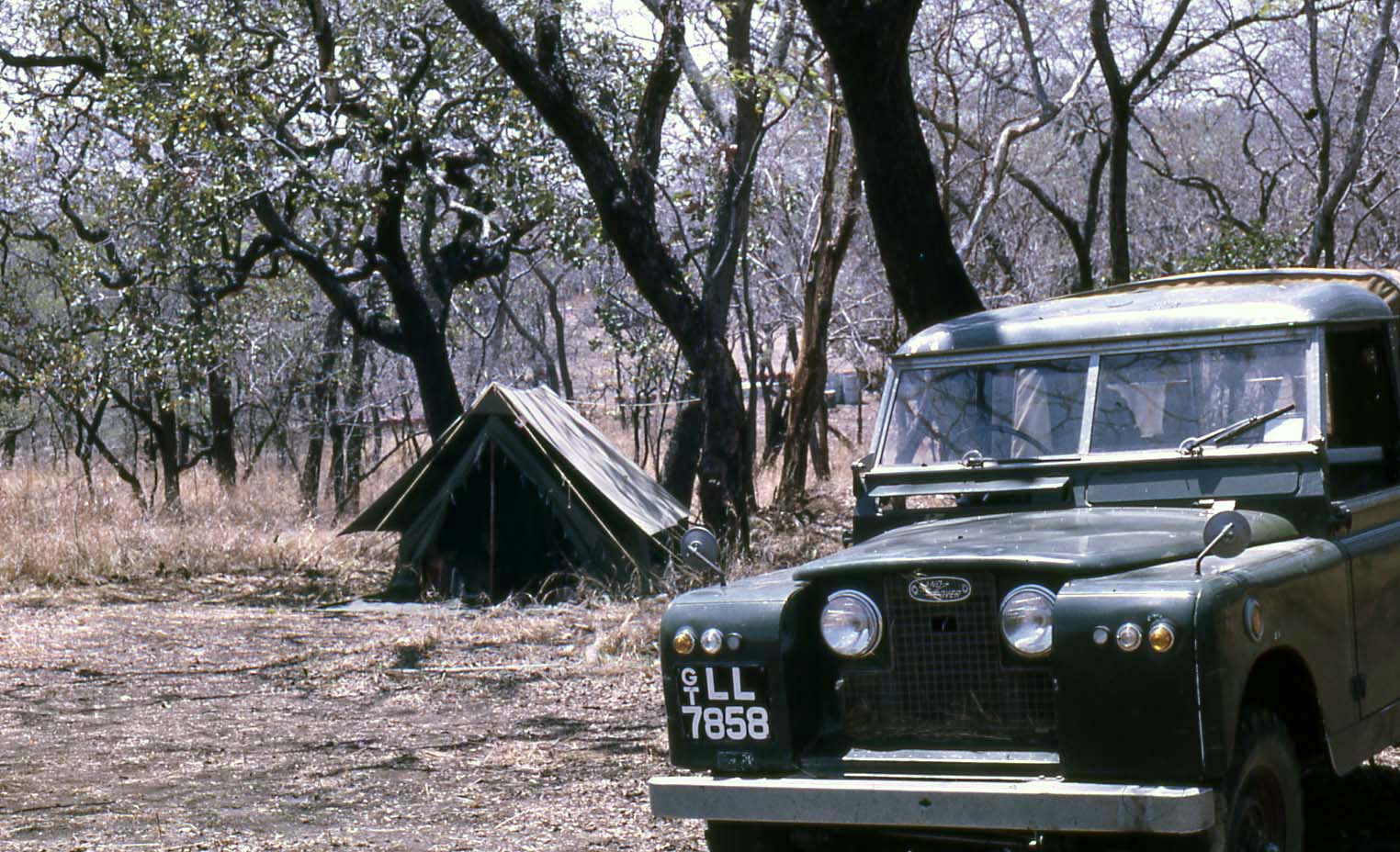
I was issued with basic camp equipment; a tent with fly sheet, a canvas tarpaulin to use as a ground sheet, a mosquito net, high-pressure kerosene lamp, a canvas stretcher with three flexible steel metal legs to sleep on, a small canvas “wash basin” into which I could pour hot water for shaving or just washing, a sturdy metal table with legs that folded up, a galvanized bucket, shovel, a folding camp chair with canvas seat and back, somewhat like a Hollywood Director’s chair (but not as comfortable) and a metal “mirror”
for use in shaving or general grooming.  In general I suppose I was issued essential items much as a soldier would receive when moving into a forward area and setting up a base camp – without MREs.

In addition I was allotted a canvas water-bag.  When filled with water, this would keep the contents cool by evaporation through the bag.  This was generally, as I learned, hung from the front rear view mirror of your Land Rover for maximum cooling effect. This didn’t work too well on the highway however.   At high speed, on a hot day, the water would completely evaporate and the water bag would be empty when you arrived at your destination.  But it did work well when hung in the shade of a tree.

Over and above these basics, I drew on my own camping experience to purchase appropriate utensils (pots and pans), cups, plates, bowls, etc. and aerosol insecticide.  A key piece of equipment was my basic shower contraption, which I assembled from a 10 gallon can with the bottom removed and a wire hanger attached.  The top end had a removable threaded metal cap. At a hardware store I bought a length of pipe, to which I attached a faucet handle and a wide spray shower nozzle.  This would screw into the hole in top of the 10 gallon can and allow me to control the flow of water.  There is a photograph here of one of the typical showers that field staff would set up when we established camp.  It consisted of a frame made of poles and sticks and a thatch covering around the outside, providing a good degree of privacy. In the middle a shallow hole was dug in the ground over which a small “raft” of sticks was placed and the water would drain through the sticks and seep away.

One of the true, great, pleasures of living in the bush is that moment, when, after a long hot day in the sun, one could step under a container of hot (or very warm) water, reach up, turn on the spigot and let the accumulated dust and sweat of the days exertions be washed away.  I soon learned that I would be covered with many little scratches, abrasions and insect bites.  So I began to add a small bottle-cap measure of a mild antiseptic solution (Sanpic) which took away the itches and stings and kept me from developing sores.

Of course, I was also issued the necessary manuals, maps, aerial photographs, hand-held compass, and documentation regarding methods and procedures for conducting a Tsetse Control field operation.  I registered my .375 magnum rifle with the authorities and would  always carry that with me.  Only once in the following two years would I have to use it for protection; for the most part it often provided the camp and our field staff and laborers with welcomed supplies of game meat.

My government-issue Land Rover was signed over to me soon after my arrival and I was schooled in procedures for obtaining fuel at Government (CMED – Central Mechanical Equipment Department) facilities.  Generally I was to find that government record-keeping procedures were easy to understand and pretty straightforward.  One just had to be careful that the thin sheets of carbon paper were placed between each of the five or six pages of each form and that you pressed firmly with the ballpoint pen and wrote on a hard
surface – such as the hood (or “bonnet”) of the Land Rover.

As far as food goes, in my first few months I stuck to the basics and, over time developed a pretty good list of essentials required to keep me nourished for the 25 days of each month I would spend in the “bush.”  I always took a bag of oranges and apples, as they kept well.  A small bag of flour, a bag of rice, a bag of potatoes, a couple of ball jars of sugar, coffee, etc., a loaf or two of bread that would last maybe a week, two dozen fresh eggs, powdered milk, a fruit juice concentrate to dilute with camp water, some canned meats and vegetables, some spaghetti and other pasta and a few boxes of cookies (or “biscuits” in the local vernacular).  I was rarely close to any towns so ‘running’ to the store for provisions was not often an option.  At times there would be a African owned store in the vicinity and these would provide basic goods such as soap, detergents, tea, soft drinks (sodas), toothpaste, etc.  It was sometimes a welcome stop at these stores as they had kerosene (paraffin) refrigerators or freezers and sometimes an ice-cold Coca-Cola or beer was a real treat. They would have a good selection of basic tools, screws and nails, wire, cast iron cooking pots and a huge
selection of items that you would not generally see in a city store. If it had ever been necessary for me to buy a bicycle, one only had to look overhead and they were hanging from the ceiling.

During one of my field assignments our camp was set up overlooking the Umniati River in the Urungwe Tribal Trust Land (TTL), not too far from a Mission called Sanyati.  In this instance we were able to receive medical treatment should any of our laborers, field officers or camp staff require it. During the two or three months that I was there two of our senior African field officers suddenly developed a severe rash. It seemed like it might be a food allergy but none of the other men had shown similar symptoms and all had been eating pretty much the same food.  The doctors at Sanyati Mission quickly diagnosed the problem as an allergic reaction to eating elephant meat. Application of a skin cream and stopping eating the elephant meat proved the diagnosis was correct and they were back to normal within a few days. We had been provided with a consignment of dried, salted, elephant meat from the Department of Parks and Wildlife and this was quite popular among most of the men. Where else in the world would an allergy to elephant meat show up as a medical emergency?    

Generally speaking, when on a long-term control operation, we would work for 25 consecutive days then return to Salisbury for R&R for five days. So we worked through the weekends and that didn’t give us a break to explore the local hot spots, even if there ever were any.  Our means of communicating with Tsetse control Headquarters was by use of a shortwave radio network.  Working on pre-established
morning and afternoon radio schedules we would call in to headquarters and give a brief daily report on progress or any unexpected occurrences or requirements.  In the event of medical emergencies we could call in at any time of the day. 
  
Soon after my preparations were complete I was sent out to my first assignment to get my feet wet (figuratively speaking of course) and learn the ropes on the forward lines of the Tsetse Wars.  A camp had been set up northwest of Karoi (now Karoyi) on the road heading north toward Makuti and Lake Kariba.  For some reason I recall taking the “Vuti” turnoff, halfway between Karoi and Makuti.

There was nothing at the turnoff except a sign saying Vuti.  From Vuti we drove about 25 or 30 miles on dirt roads and past very productive farms in a Native Purchase Area.  NPAs had been established in Rhodesia many years before to give local tribesmen the ability to buy and hold title to their own land.  This was leading more and more people to move away from the traditional “subsistence farming” mentality that was restricting crop production and prosperity across most countries of Africa.  On my way past the first NPA farms
I had ever seen there were hundreds of bags of harvested cotton awaiting transport to market. Rhodesia, at the time, was producing ever increasing crops of cotton and natives in these NPAs were earning significant cash incomes from their efforts.

I remember talking about this success to an agricultural extension officer in the town of Karoi who told me that each year, several of  the native farmers from the NPAs would come into town after a successful cash crop harvest and buy a new tractor or other implements and pay cash for them.

In my next blog I will describe a typical “Tsetse Fly Control operation” and discuss the seriousness of the tsetse fly threat that exists in Africa today - as it did in the 1960s. 


24 April 2011

Camping, eels, and heavy rain

Mountain View Farm, Eastern Cape Province, South Africa c.1964

The four of us, my brother and me, and Charles and David Hayes, had camped several times on Mountain View farm each year since I was thirteen.  When I was 17, we thought we would try something new and camp “up river” where the Elands River passed through a narrow valley in a series of pools before spilling out into a long rocky section.  It was still summer, so the freezing cold nights of our winter wouldn’t be on the agenda.  The possibility of rain was greater however.  Our new camp in Rocky Valley was a fairly long hike from the farm house, over a spur and along a narrow trail, so we packed only what was essential.  We took a fly-sheet this time and no tent.  We also took some of the fishing tackle we would need to catch eels.  There were six of us on this trip as friends Dougie Anderson and Mike Viljoen had joined us.

We had to cross the river in a very rugged rocky section, jumping across small cascades and pools.  We realized that if the river rose it would be difficult to return by the same route but how likely was that?  Crossing the river at this point was the remainder of an old pipeline which had been used to pipe water to the valley below. There were five or six concrete columns spanning the river and across the top, about 12 feet above the rocks, was a steel I-beam which looked to be about six inches wide that had supported a pipe. The pipe that must have been there at one time had long since been removed for use elsewhere.  Sections of a rusted and broken handrail ran alongside the steel beam.  We figured that, in an emergency, we would be able to cross the rocks on the 12 foot high “bridge” but didn’t ever think we would actually have to do that.

A hundred yards or so after the river crossing we set up a really nice camp in a shady space next to a deep dark pool in the river.  The valley was narrow here and steep hills rose up on either side of the river.  This camp would soon be named “Texas.”  A few of the group had brought “Texan” cigarettes with them, so we christened our new camp in honor of their choice of cigarettes.

Eel fishing was something new.  To catch eels we had to catch live frogs to use for bait. At the end of a long length of nylon cord we tied a swivel and then a 12 inch long piece of stainless steel tracer with another swivel at its end.  To this a large, very sharp, hook was attached.  After setting up camp we hiked downstream to fish for large-mouth bass. In some of the clear pools we could see them lurking in the deep shady areas.  A couple of good bass lures (a ‘jitterbug” and “hula popper” among them) soon landed us three or four pan-size fish for dinner.

Back at camp we collected wood and made a nice fire and soon we were ready to cook our fish.  We would generally fillet the fish in two halves, and put the two scaly sides together.  Then we wrapped the two sides of each fish in aluminium (aluminum) foil with a little butter on the fleshy sides.  These foiled-wrapped bass were then placed on the hot coals and covered with more hot coals.  After ten or fifteen minutes we took them from the fire, peeled away the foil, leaving the two scaly skins stuck together, removed the tender, juicy and flavourful meat.  These baked fish meals were something I will always remember with relish. 

As everyone knows, the best time to catch frogs is at night.  After a gourmet fish dinner we headed for the rock pools of the river with our torches (flashlights).  Frogs don’t move very well when blinded by the light of a torch and it didn’t take long to catch half a dozen of the slippery amphibians.  Back at camp, with our bucket of frogs we baited the eel lines by tying the frogs onto the hooks with nylon fishing line.  They were still kicking when we threw the lines into the dark pool, tied the cord lines to a tree or stump and went back to the fire. This is not the sort of fishing that requires a lot of concentration. We would check the lines in the morning.

The following day we pulled in the lines and found we had caught a few eels. I can’t actually recall why we were fishing for them.  They were incredibly strong and had twisted the stainless steel tracers into tight knots. They were also still very much alive and had swallowed the bait whole.  We had to chop their heads off to kill them and then we decided to try and cook them by wrapping them in foil and baking them as we had the bass.  That wasn’t a great success.  Eels are boney and not very tasty. The fact that I can’t remember how they tasted is probably a good indication that they tasted pretty bad.

Later that day we were visited by all of the Whitehead cousins from Mountain View and from Forest Glade, a few miles up the valley.  Jennifer Whitehead from Mountain View and her first cousins Elmarie, Yvonne and Marlene from Forest Glade, came hiking up the river to our camp on a hot sunny day.  They often brought us something special to eat.  One of my favorites was caramel, made by boiling a can of sweetened condensed milk until it turned to caramel.  We always had a good time with the girls.  They were friendly, sociable and fun to visit with.  By the afternoon they had gone home.  The skies clouded over and towards evening we knew we were in for a pretty good thunderstorm.

It began to rain and we hunkered down by the fire, hoping it would blow over in an hour or so.  A few hours later it was still raining with increasing thunder and lightning and with the persistent rain we could see, and hear, the river beginning to rise.   By about 9:00 p.m. we were drenched and getting cold and we knew we would have to get out of camp and cross the river while we still were able.  After tucking a few essentials into our backpacks and covering the food and sleeping backs with a fly-sheet we left Texas – at least for the night – not entirely sure where we would go.  The first challenge would be crossing the river with the pools now too deep to jump across and the rocks made slippery from the rain.  It soon became obvious that we would have to cross by climbing up on the old steel beam, high above the rocks and crawl the 50 yards or so on our hands and knees.  It was, by now, raining really hard and the idea of being soaking wet, holding on to a metal beam, high above a rocky river, with lightning flashing above us wasn’t too appealing.

The soaked, cold, bedraggled six eventually made it across. The darkness made it easier because visibility was so bad we couldn’t see the rocks below us and when the lightning flashed I instinctively closed my eyes.  After what seemed an eternity the six of us were safely on the muddy trail leading down the valley. It didn’t take long to decide we would have to head for the farmhouse at Forest Glade. It was about a mile closer than Mountain View and in those conditions a mile less was significant. I don’t remember what time we arrived at the farmhouse but it was probably around midnight.  The house was in darkness when our totally drenched bunch of 16 and 17 year old campers knocked on the door.  

Soon Mrs. Whitehead, her older daughters and their cousin Jennifer, had us wrapped in towels and standing in front of a roaring fire.  Hot cups of tea lifted our spirits and our wet clothing was peeled away (down to the bare essentials anyway).  We were miraculously warm again after several hours of shivering in the cold.  Before too long we were all sleeping on the living room floor, wrapped in blankets and warm hospitality.

In the morning hot coffee was followed by a wonderful breakfast of sausages, eggs and scones, with farm produced honey.  The sun came out and another beautiful day lay ahead of us.  Our arrival at Forest Glade in the dead of night, in a heavy storm, and sleeping on the floor, was the topic of conversation for many years.  This
adventure from my youth happened 50 years ago and I recently received an e-mail from Jennifer Eldridge (nee Whitehead) who recalled the weekend when the Forest Glade farmhouse was filled to capacity with everyone sleeping on the floor.  Such are the enduring memories from one’s childhood and teenage years.

12 March 2011

Friendships and camping

Victoria Falls - from the air, photo taken August 2004

    We have booked our reservations for the July 2012 trip - at least the Zimbabwe part of the trip.  Deposits for the safari camps will have to be paid by September and we will confirm our plane tickets at the same time.  The plan for our South African travel hasn't been worked out yet but it looks like we will fly from Victoria Falls to Johannesburg on July 25, and spend the next ten days along the southern coast from Port Elizabeth to Cape Town.

Friends and camping.

    In 1957, soon after entering Std. VI (8th grade), my brother and I were approached by David Hayes and asked if we would like to go camping on his grandparents' farm. David and I would soon begin a friendship that has lasted 54 years. David's grandparents owned a farm about 20 miles west of Uitenhage, along the Elands River. It was, at the time, and certainly remains today, one of the most beautiful and picturesque places I have ever known. Without intending to go into a long and complicated story at this point, I still need to provide some back ground to the events that would follow in subsequent years after becoming friends with David and his older brother Charles. 
 
    My dad was an avid hunter. He learned to hunt from his father and from an early age my dad and my grandfather would hunt to put food on the table. The backwoods of Alabama would provide rabbit, turkeys and deer to supplement their often meager provisions. My twin brother and I had learned to shoot and to safely handle firearms at an early age. For our 10th birthday we were given single-shot, bolt action, .22 caliber rifles and taught basic shooting skills. 

    One of the managers at the Uitenhage Goodyear plant was George Whitehead, who learned of my dad's interest in hunting. It wasn't long before my dad was invited to a weekend hunt at Mountain View Farm, the home of George's parents. It was a successful hunt for my dad who became friends with the Whitehead family. In the next few years he established himself as a competent hunter and an excellent marksman; ultimately providing him with an ever-widening circle of farmers and hunting enthusiasts in the region who would give him opportunities to hunt. His knowledge of and interest in the amazing variety of wildlife in the area grew over the years; as did his circle of friends.
    
    David and Charles Hayes were George Whitehead's nephews. They were the two sons of his sister Hilda Hayes who, along with their older brother Stan, were born and raised on the farm Mountain View. The family had generously suggested to my dad that my brother and I might like to spend a few days on the farm camping and this led to the first of many adventures for the four of us. David was a year younger than we were, and Charles was a year older. David and I became partners in many excursions into the beautiful valley at Mountain View and Charles and John teamed up to try our patience at times, but to always ensure there were no dull moments.
Mountain View Farm - photographed in January 1964.
    It is difficult to adequately describe the farm. It was, in those days, a nine mile (15km) drive on a paved road southwest out of Uitenhage across the Swartkops River to a right turn at Rocklands. A few rural houses and a chicken farm were the most notable features. In the 1950s, Rocklands also featured a wildlife sanctuary of sorts, called Wide Horizons. It displayed a variety of animals in relatively confined fenced areas and cages. By today’s standards Wide Horizons would not have been permitted to operate. Fortunately for its inhabitants, it closed down in the 1960s. Most interesting to me, on the one or two occasions that I stopped there, were the variety of birds we could see, such as peacocks, turkeys and many species of colorful South African birds such as Knysna Louries. 
 
    Much of the gravel road from Rocklands heading in a northwesterly direction is paved now but back then it was a dusty, often badly corrugated, road. About 12 miles (20km) from Rocklands, a short distance after passing the Sand River Dam on the left, we would take an unmarked turn right onto the farm road in the middle of a stand of Eucalyptus (or Blue gum) trees. Through several gates and over cattle grids (guards) the narrow three mile (5km) dirt road from there passed by rounded hills covered with wild proteas (suikerbos) and thick shoulder high shrub vegetation. On the right was ploughed, dry-land cropland, planted with winter wheat, lucerne, maize (corn) and other grains depending on the season. The last mile of the road descended down a steep mountain side with several switchbacks into the Elands River valley. In the distance, about a mile away you could see the small, old traditional Cape Dutch style farmhouse, built here fifty years earlier by George Whitehead. Behind the house, the mountains rise steeply to what is now designated the Groendal Wilderness. It is a wild and remote mountainous area, frequented now mostly by backpackers. There are no roads and only limited 4-wheel drive access.

    After the steep descent into the valley you came to the Elands River and a rocky crossing. When the river was high, as occurred generally once or twice a year, crossing was only done by horseback or by a tractor pulled trailer. The wide valley floor in front of the farmhouse and further south along the valley was dotted with citrus orchards and some deciduous fruits such as apricots. Grandpa Whitehead, we were told, could sample a tangerine or orange from one of his orchards and tell you almost exactly where it was picked. I vividly remember his stories of the troops of baboons that would come into the valley each year and eat his oranges.
    He told us that baboons could count to three but no higher than that. He would build a hide in the orchard and four armed men would go into the hide. One by one three hunters would come out, making their movements obvious to the distant baboon troop. The fourth man would remain in the hide and the baboons would, in due course, venture into the orchard and begin to eat the fruit. They were very destructive because they would pluck one fruit from the tree, take one bite and throw the remainder on the ground. A family of baboons could cause a great deal of damage in a very short period of time. When the apes came within range the fourth armed man could open fire and kill a few of the unsuspecting marauders. This plan would not work if only three men went into the hide and two came out. The monkeys always knew there was one human remaining and they would stay away until he left.

    The presence of baboons was a sure indicator that there were leopards in the area. Over the years, the Whiteheads had shot a number of leopards that would become too attracted to their livestock, but for the most part, leopards sightings in the valley were rare. I can only recall seeing leopard tracks once in the years that we would camp at Mountain View.

   John and I and David and Charles would camp in this valley many times over the next four or five years. Whenever we would ask my father if we could go camping he would insist that we could only go if personally invited by the elder Whiteheads. It wasn't okay that David or Charles would ask us. So we soon developed a “protocol” to conform to my dad's requirement. The four of us boys would decide on dates to go camping and begin making plans; then David would ask his mother to ask his grandparents if it was alright. Within a day or two my dad would get a call from one of the Whiteheads asking if we could come out for a long weekend.

    The Elands River valley is a perfect place for four young boys to camp, and fish and hunt. It is, when not too high from seasonal rain, a crystal clear river with many rocky pools (read swimming holes), ideal for fishing for large-mouth bass. We would often look into the deep pools in the early morning and see bass lurking in the shadows. Consequently a rod and reel was always part of our essential equipment, as was a roll of aluminium (aluminum) foil. We would return to camp with two or three, one to two pound bass, cut the heads and tails off, and fillet them. The two sides, still with scales on them, were put together and the whole was wrapped in foil with a few dabs of butter. The sealed foiled package would be buried in the coals of the camp fire and allowed to bake for 10 to 15 minutes. When done, we would remove it and open the foil package. The flesh would fall away from the skin and the tender meat was easy to pare away from the bone. I can still taste this delicacy as I think about it.

    We usually carried a shotgun with us and from time to time would bag a few pheasant or quail to cook. David or his brother would sometimes borrow a .22 caliber rifle from their grandfather in case we would see a bushbuck or duiker on our wanderings. Both are small African antelope that make good eating. We even had a few exciting night hunts for rabbits and springhares, those rabbit-sized hopping rodents that look like midget kangaroos in the distance in the glare of a powerful flashlight (or “torch”). Springhare hunts would have to attempted on moonless nights. I remember one night when we came across a porcupine and followed it for a while, its sharp white-tipped quills bristling with annoyance at our intrusion.

    Our camping spots along the river were always chosen with care. Although we always took a tent or large canvas or plastic fly-sheet with us for shelter, we rarely used it. On winter (July) nights it was too cold to sleep in a tent. Our sleeping bags, in those days, weren't particularly warm, so we would lay on the ground as close to the fire as we could and sleep there. The first person to get cold enough would reach over and put more logs on the fire to keep the heat “turned on.” On those nights the temperatures would sometimes get down to just above freezing and heavy frosts would cover the grass and fields. 

The only photo I have of Granny Whitehead, (1973) holding my son Graham.
 
    After a cold night on the ground we would often put on our heavy coats and walk to the house where Granny Whitehead would have hot coffee or tea prepared on the wood-fueled cast iron stove in the kitchen. She was the most wonderful, generous and hospitable person you could imagine. I don't believe I ever saw her sitting still. She always seemed to be cooking or sewing, knitting or arranging something. Grandpa George would always greet us with his loud booming voice and you could never meet him in the morning without a shake of his powerful hand. He was in his seventies when we first knew him. He was broad-shouldered and powerfully built and would often saddle up a horse and ride along the river to check on his orchards or his cattle. Together they had settled in this valley, built this farmhouse and raised three children. For most of their years here there had been no electricity. Water was collected from a small mountain stream about half a mile away and was piped by gravity into tanks adjacent to the house. A small staff of dedicated, friendly employees, many of whom had been born here, helped them run the farm. Most were descended from bushmen and had the small stature and fair complexions of that race.

    We would have many adventures on this farm. The Whiteheads were substitutes for the grandparents that my brother and I had left behind in Alabama. I know that my dad, despite his insistence that we always go there by “invitation only” must have been delighted that we had the opportunity to experience the adventures that we had, especially as my mother's alcoholism would continue to grow more difficult to deal with. He would always listen to our stories and laugh when we described some of the things we would get up to.

___________________________
    I will tell a few more stories from the farm in my next blog including our run-in with a skunk, and the night we had to leave our camp in a torrential rain as the river began to rise.
Mountain View Farm in 1999. Groendal Wilderness is in the background.