Showing posts with label Makuti. Show all posts

03 September 2011

Animal Encounters - First Elephant

As a Field Entomologist in Tsetse Control in Rhodesia (1967-68), much of my time was spent in pretty remote areas of “the bush.”  I would write to my parents, who were living in South Africa at the time and describe my employment as “working in a zoo,” only there were no cages. I had a camera with me, but took far too few photographs.  I also always had a rifle with me.  Occasionally I could provide a little fresh meat for our camp and only once did I almost have to use my .375 magnum to protect myself.

During the height of the rainy season, from December through March, movement in many back-country areas was limited by wet and often impassable roads. The weather from April through October was about as predictable as weather could be, sunny dry days, cool clear nights.

As anyone who has been “on safari” in Africa can testify, when around wildlife there is always an unexpected event or sighting around the next bend in the road.  It may not occur for many, many, hours, or even days, but it always leaves an indelible memory.  Just as you begin to wonder where the game is, it pops up to excite and amaze you. This was certainly my experience as a young, enthusiastic lover of all wild places and animals, suddenly finding myself in a professional situation that few have an opportunity to experience in their lives. Growing up through my teen years, I was able to join my dad on occasional hunts for small game. These were always enjoyable and taught me solid lessons, but I have never been, nor would I ever describe myself as a “hunter.” The main lessons I learned were how to shoot well and how to treat a firearm with great respect.

Being in Tsetse Control did not give anyone a license or permission to hunt.  We were able to shoot only in clearly designated areas and under strict guidelines. There was never an attempt to take on the role of the professional game rangers and wardens of the Department of National Parks and Wildlife Management.

One of the most memorable days of my life was the first time I saw elephant in the wild.  I had seen them many times in game reserves, from behind a fence or from the safety of a car but never while on foot.   I had spent several weeks on a spraying operation in a remote area on the southern edge of the Zambezi Escarpment due south of Lake Kariba.  These operations were conducted for 25 consecutive days, beginning on the first day of each month.  Everyone would go for “R & R” from the 25th to the 31st to make up for the weekends that we had worked. Field Officers would return to Salisbury (now Harare) for a well deserved break, and to re-provision for the following month. The laborers; most recruited from local villages, would return home to their families and their chores.
Elephant footprints (spoor) in sand

On this occasion, in August 1967, my boss Bill Casey had arranged to take me to a Tsetse Research station called Reckomechi.  I rendezvoused with Bill in the small town of Makuti and left my Land Rover at the local Government depot while we continued in his vehicle.  From Makuti, the two-lane paved highway descends almost immediately into the Zambezi Valley in long sweeping curves through dense bush.  The valley floor is flat and the most noticeable change in vegetation is the increased number of baobab trees; those huge grey hulks that seem as though they have been thrust into the earth upside down.  As the highway flattens out to cross the valley floor north to the Zambezi River and the Zambian border post called Beit Bridge, we turned right onto a dusty road heading east toward Mana Pools, the renowned Game Reserve.

The dirt road is straight, except for a few times when its geometrically perfect bearing was impeded by an old baobab tree; then it would bend just enough to skirt the obstruction.  After about 30 miles on this hot, dusty road we passed the turn to Mana Pools and soon arrived at Reckomtjie, a loose assemblage of metal prefab buildings which served as labs, offices and accommodations.  We met the Tsetse Officer in charge and his wife and as the late afternoon shadows began to lengthen, Bill Casey suggested we take a walk to the nearby Reckomtjie River.  So, we made our way through the small vegetable garden at the back of the house and followed a narrow path descending into the river.  The river, as is typical in this area, was lined on either side by huge, old hardwood trees, teak, ebony and ironwood.  The wide sandy river bed appeared completely dry although from the holes that had been dug by elephant, there was obviously water not too far below the surface. We reach the bed of the river and crossed a narrow sandy area before climbing up onto a large earth mound, about 10-12 feet high, fortified by a number of large trees. It was literally an island in the dry river bed which was about 40 yards wide at this point.

Looking directly north, the sand ran straight into the shade of overhanging trees, as though disappearing into a tunnel.  Behind us, to the south, the river bed ran up against a vertical red earthen cliff as it turned to the left and began its ascent into the distant hills. I could imagine how it might be during the rains, when thunderstorms would build over the higher country and the rushing torrents would spill into the valley along this dry sandy highway.  Bill and I sat down on top of our “island” and enjoyed the peace and quiet for a few minutes.  Before long we saw the grey, ambling hulks of a herd of elephant begin to appear out of the shadows to the north.  They were walking purposefully, in single file, with an old matriarch in the lead. As they got closer, we could see there were perhaps twenty animals in the group, mostly females, with several calves and a few immature males.  It reminded me of the tame elephants I had seen as a young boy at Ringling Brothers Circus, when the elephants would enter the big top and walk around the ring holding each other by the tail.

Now of course they smelled us and the column slowed briefly. Then they separated into two lines, with one row passing on our left and the other to our right.  From our small hilltop, we could almost have reached out and touched them. As they passed, we were close enough for them to see us, and a few lifted their trunks to test the air.  I realized that, in the excitement of the moment, I had been holding my breath.  I also remember how quietly these huge, gentle animals were moving.  As the last one passed, we turned to watch them continue up-river and soon disappear around the bend below the cliffs.

This herd had come out of the vast Mana Pools Game Reserve and, had probably not been poached or hunted.  This explained their acceptance of the smell of humans and the fact that, despite the presence of young in their herd, we were not perceived as a threat.  In the near future I would encounter elephant in other parts of the country and in different circumstances where the smell of humans would throw them into a panic. The following morning, I walked up-river from this spot and saw where the herd had excavated holes in the riverbed and exposed pools of water.  During this time of the year, when rain would not come for many more months, elephants provide a source of water for many other wildlife species by digging into the dry river beds. 

Water revealed by elephant in a dry river bed.

It’s 44 years later and I still have the sharpest memories of that late afternoon in the Reckometjie River.  That was the moment when I began a love affair with elephants and started to develop an understanding of just how remarkably intelligent and gentle they are.  

Next - encounter with a Cape Buffalo, and then a black mamba and an eland.

12 June 2011

Africa Travel Diary: Tsetse Wars - mobilization

Africa Travel Diary: Tsetse Wars - mobilization: "My first camp as a Field Entomologist A typical shower installation in camp. I became a Field Entomologist with the Tsetse & Trypanoso..."

11 June 2011

Tsetse Wars - mobilization


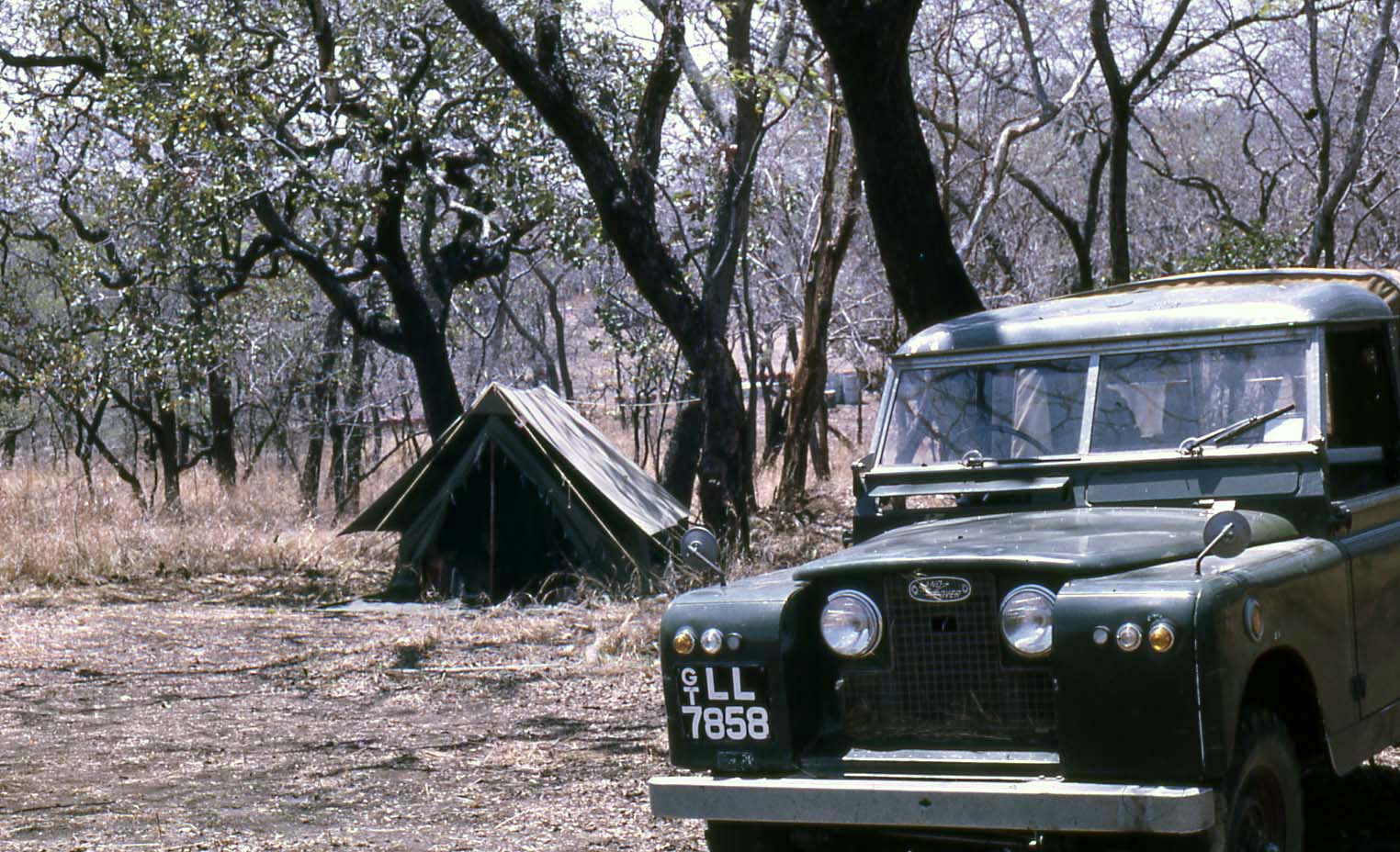
My first camp as a Field Entomologist
A typical shower installation in camp.
I became a Field Entomologist with the Tsetse & Trypanosomiasis Branch of the Department of Veterinary Services in Rhodesia in July 1967.  I had driven north into Rhodesia from the South African border post at Beit Bridge, in my relatively new Volkswagen Beetle, to begin a new chapter of my life.  My home for the previous six years had been Grahamstown, South Africa, where I had studied Zoology and Entomology and worked in the Department of Zoology at Rhodes University as Senior Lab Technician. 

Rhodesia, for me, was a breath of fresh air.  The Apartheid policies of the South African Government had not permeated Rhodesian society.  Race relations were completely different and this was immediately apparent in all walks of society, where blacks held positions in commerce and in government departments and in private industry unlike I had seen before in South Africa.
     

A few examples come to mind.  Most commercial and public transport drivers were blacks.  In South Africa, job reservation (or protection) policies prohibited blacks from operating many forms of public transport, including buses, and reserved those occupations for whites only.  In Rhodesia one could go into a Post Office or a Bank and most other businesses and expect to be waited on by a black or white employee.  It was not unusual to be attended to by a black nurse or doctor, particularly in rural areas. Across the broad spectrum of jobs, those who were qualified to hold positions were able to compete for those positions and be paid on a standard scale of pay.

There were exceptions, of course, such as the fact that most public schools were still reserved for blacks or whites. But the society had been integrated to an extent that I had not seen in my 12 years in South Africa.  Over the next 13 years that I was to live in this rich and diverse country, significant progress continued to be made in integrating the races more fully and breaking down old divisions. 

In any event, I reported for my new job in the Tsetse Control offices located among the buildings and research facilities in the Agricultural Research Station north of the City of Salisbury (now Harare) in an area known as “the avenues.”  I had brought most of my meager possessions with me in a metal trunk (27 in. long by 12 in. high by 16 inches deep) with a hinged lid and a padlock.  This, I figured, would be a valuable thing to have when living in a tent in the middle of nowhere.  It soon proved its value by being impervious to rain, spiders, scorpions and snakes, while keeping much coveted food such as jars of sugar safely out of the hands of
less-than-honest camp thieves.  After 44 years this metal trunk sits securely in the basement of my house and holds many mementos of my days in Africa.
   
I was issued with basic camp equipment; a tent with fly sheet, a canvas tarpaulin to use as a ground sheet, a mosquito net, high-pressure kerosene lamp, a canvas stretcher with three flexible steel metal legs to sleep on, a small canvas “wash basin” into which I could pour hot water for shaving or just washing, a sturdy metal table with legs that folded up, a galvanized bucket, shovel, a folding camp chair with canvas seat and back, somewhat like a Hollywood Director’s chair (but not as comfortable) and a metal “mirror”
for use in shaving or general grooming.  In general I suppose I was issued essential items much as a soldier would receive when moving into a forward area and setting up a base camp – without MREs.

In addition I was allotted a canvas water-bag.  When filled with water, this would keep the contents cool by evaporation through the bag.  This was generally, as I learned, hung from the front rear view mirror of your Land Rover for maximum cooling effect. This didn’t work too well on the highway however.   At high speed, on a hot day, the water would completely evaporate and the water bag would be empty when you arrived at your destination.  But it did work well when hung in the shade of a tree.

Over and above these basics, I drew on my own camping experience to purchase appropriate utensils (pots and pans), cups, plates, bowls, etc. and aerosol insecticide.  A key piece of equipment was my basic shower contraption, which I assembled from a 10 gallon can with the bottom removed and a wire hanger attached.  The top end had a removable threaded metal cap. At a hardware store I bought a length of pipe, to which I attached a faucet handle and a wide spray shower nozzle.  This would screw into the hole in top of the 10 gallon can and allow me to control the flow of water.  There is a photograph here of one of the typical showers that field staff would set up when we established camp.  It consisted of a frame made of poles and sticks and a thatch covering around the outside, providing a good degree of privacy. In the middle a shallow hole was dug in the ground over which a small “raft” of sticks was placed and the water would drain through the sticks and seep away.

One of the true, great, pleasures of living in the bush is that moment, when, after a long hot day in the sun, one could step under a container of hot (or very warm) water, reach up, turn on the spigot and let the accumulated dust and sweat of the days exertions be washed away.  I soon learned that I would be covered with many little scratches, abrasions and insect bites.  So I began to add a small bottle-cap measure of a mild antiseptic solution (Sanpic) which took away the itches and stings and kept me from developing sores.

Of course, I was also issued the necessary manuals, maps, aerial photographs, hand-held compass, and documentation regarding methods and procedures for conducting a Tsetse Control field operation.  I registered my .375 magnum rifle with the authorities and would  always carry that with me.  Only once in the following two years would I have to use it for protection; for the most part it often provided the camp and our field staff and laborers with welcomed supplies of game meat.

My government-issue Land Rover was signed over to me soon after my arrival and I was schooled in procedures for obtaining fuel at Government (CMED – Central Mechanical Equipment Department) facilities.  Generally I was to find that government record-keeping procedures were easy to understand and pretty straightforward.  One just had to be careful that the thin sheets of carbon paper were placed between each of the five or six pages of each form and that you pressed firmly with the ballpoint pen and wrote on a hard
surface – such as the hood (or “bonnet”) of the Land Rover.

As far as food goes, in my first few months I stuck to the basics and, over time developed a pretty good list of essentials required to keep me nourished for the 25 days of each month I would spend in the “bush.”  I always took a bag of oranges and apples, as they kept well.  A small bag of flour, a bag of rice, a bag of potatoes, a couple of ball jars of sugar, coffee, etc., a loaf or two of bread that would last maybe a week, two dozen fresh eggs, powdered milk, a fruit juice concentrate to dilute with camp water, some canned meats and vegetables, some spaghetti and other pasta and a few boxes of cookies (or “biscuits” in the local vernacular).  I was rarely close to any towns so ‘running’ to the store for provisions was not often an option.  At times there would be a African owned store in the vicinity and these would provide basic goods such as soap, detergents, tea, soft drinks (sodas), toothpaste, etc.  It was sometimes a welcome stop at these stores as they had kerosene (paraffin) refrigerators or freezers and sometimes an ice-cold Coca-Cola or beer was a real treat. They would have a good selection of basic tools, screws and nails, wire, cast iron cooking pots and a huge
selection of items that you would not generally see in a city store. If it had ever been necessary for me to buy a bicycle, one only had to look overhead and they were hanging from the ceiling.

During one of my field assignments our camp was set up overlooking the Umniati River in the Urungwe Tribal Trust Land (TTL), not too far from a Mission called Sanyati.  In this instance we were able to receive medical treatment should any of our laborers, field officers or camp staff require it. During the two or three months that I was there two of our senior African field officers suddenly developed a severe rash. It seemed like it might be a food allergy but none of the other men had shown similar symptoms and all had been eating pretty much the same food.  The doctors at Sanyati Mission quickly diagnosed the problem as an allergic reaction to eating elephant meat. Application of a skin cream and stopping eating the elephant meat proved the diagnosis was correct and they were back to normal within a few days. We had been provided with a consignment of dried, salted, elephant meat from the Department of Parks and Wildlife and this was quite popular among most of the men. Where else in the world would an allergy to elephant meat show up as a medical emergency?    

Generally speaking, when on a long-term control operation, we would work for 25 consecutive days then return to Salisbury for R&R for five days. So we worked through the weekends and that didn’t give us a break to explore the local hot spots, even if there ever were any.  Our means of communicating with Tsetse control Headquarters was by use of a shortwave radio network.  Working on pre-established
morning and afternoon radio schedules we would call in to headquarters and give a brief daily report on progress or any unexpected occurrences or requirements.  In the event of medical emergencies we could call in at any time of the day. 
  
Soon after my preparations were complete I was sent out to my first assignment to get my feet wet (figuratively speaking of course) and learn the ropes on the forward lines of the Tsetse Wars.  A camp had been set up northwest of Karoi (now Karoyi) on the road heading north toward Makuti and Lake Kariba.  For some reason I recall taking the “Vuti” turnoff, halfway between Karoi and Makuti.

There was nothing at the turnoff except a sign saying Vuti.  From Vuti we drove about 25 or 30 miles on dirt roads and past very productive farms in a Native Purchase Area.  NPAs had been established in Rhodesia many years before to give local tribesmen the ability to buy and hold title to their own land.  This was leading more and more people to move away from the traditional “subsistence farming” mentality that was restricting crop production and prosperity across most countries of Africa.  On my way past the first NPA farms
I had ever seen there were hundreds of bags of harvested cotton awaiting transport to market. Rhodesia, at the time, was producing ever increasing crops of cotton and natives in these NPAs were earning significant cash incomes from their efforts.

I remember talking about this success to an agricultural extension officer in the town of Karoi who told me that each year, several of  the native farmers from the NPAs would come into town after a successful cash crop harvest and buy a new tractor or other implements and pay cash for them.

In my next blog I will describe a typical “Tsetse Fly Control operation” and discuss the seriousness of the tsetse fly threat that exists in Africa today - as it did in the 1960s. 


21 May 2011

A Glossinologist is born

Glossina morsitans - scourge of Africa (from:Wikipedia)

The Tsetse Fly is a pest. It resembles a horsefly in size but it is only found in Africa and it packs a really annoying and painful bite.  I learned about the Tsetse Fly while pursuing a Bachelor of Science degree at Rhodes University in Grahamstown, South Africa.  I experienced my first bite on December 26, 1966 while visiting Rhodesia for the first time.  I was driving my red 1300cc, Volkswagen Beetle from the small village of Makuti to Lake Kariba. My friend from Rhodes, Andrew Campbell-Watt, was sitting next to me and I suspect he will remember our road trip around Rhodesia as well as I do.
The Zambezi Escarpment near Makuti

As we descended the “escarpment” along the scenic two-lane highway into the Zambezi Valley the summer heat began to rise as the elevation steadily dropped; from 3,200 ft. to 1,590 ft (485M) at the lake.  The only air conditioning option was the open-window kind.  The rounded hills were covered with Msasa trees.  Today it is more common to call these areas Miombo Woodland, but back then the vegetation was called Brachystegia Woodland (from the tree genus Brachystegia).   These woodlands extend from Rhodesia (now Zimbabwe) north through Tanzania and Kenya and serve as hosts to the amazing diversity of wildlife found across the vast African continent, south of the Sahara Desert.  We crossed many dry river beds over concrete bridges and causeways on the 48 mile (77km) highway.  
Famous mile-marker at Makuti - 2001.  Kariba 77km.
When passing through Tsetse Fly country it is risky to slow down and to drive with windows open.   In one of the low places we made the mistake of slowing down as we crossed a stream bed.  The vegetation in these low areas is thicker, and game populations tend to be more concentrated.  Tsetse Flies feed on the blood of wild mammals (antelope, elephant, warthog etc.) and also breed and congregate in dense numbers where wildlife populations are highest.  They also tend to rest in shady spots – such as the underside of concrete causeways over which people in red Volkswagens pass.

The Tsetse fly is a tough critter.  It flies fast and can land on your skin without you feeling it.  It’s the most amazing thing.  It will be sitting on your arm or leg or on the back of your neck and you can’t feel it.   And then there are its piercing mouth-parts, perfectly adapted over millennia to penetrate tough skin to tap a hot, juicy blood vessel.  The first clue that it is biting is the pain, like a hot needle.   They almost always seem to land on your body somewhere out of sight.  I was driving with both hands on the steering wheel and one of those annoying critters landed on one of my fingers, just about the nail and proceeded to stick its sharp little proboscis into my finger.  Ouch!  I nearly lost control of the car!

Once bitten you begin to imagine flies all over your body and you begin to fidget like mad, running your hands up and down the backs of your legs and over the back of your neck and shoulders, just in case one has come to rest and is about to stick its little dagger through your thin cotton shirt.   Andrew and I completed our passage to Kariba Town without more Tsetse Fly attacks, mainly by speeding up so the flies couldn’t catch us.

Lake Kariba on the Zambezi River - 165 miles long.

Over the next few years I would become very familiar with the Tsetse Fly.  Glossina morsitans is its name in scientific circles. During my first road trip to Rhodesia that December 44 years ago, two significant things occurred in my life.  First, I fell head over heels in love with that beautiful country and its people, and second I interviewed for a job as a Field Entomologist with the Ministry of Agriculture, Department of Veterinary Services, Tsetse and Trypanosomiasis Control Branch (Tsetse Control for short).  A few weeks later I received a letter offering me the position and I accepted without hesitation, but replied that I could only report for work in July 1967.  


I had already made a commitment to stay on as Senior Lab Technician at Rhodes University until early June, and then to volunteer as an Instructor at the Veld & Vlei Adventure (VV&T) School in Sedgefield, South Africa, later that month.  VV&T would become part of the worldwide Outward Bound organization a few years later.  Fortunately the good people of Tsetse Control agreed that I could delay my start.  The rest, as some might say, is history.

In July I reported for work in Salisbury (now Harare) and began playing a small role in trying to reduce the unbelievable economic damage and hardship that was, and still is, caused by this little insect, across the African continent.   My life as a Glossinologist would begin.

But more about that in my next blog.